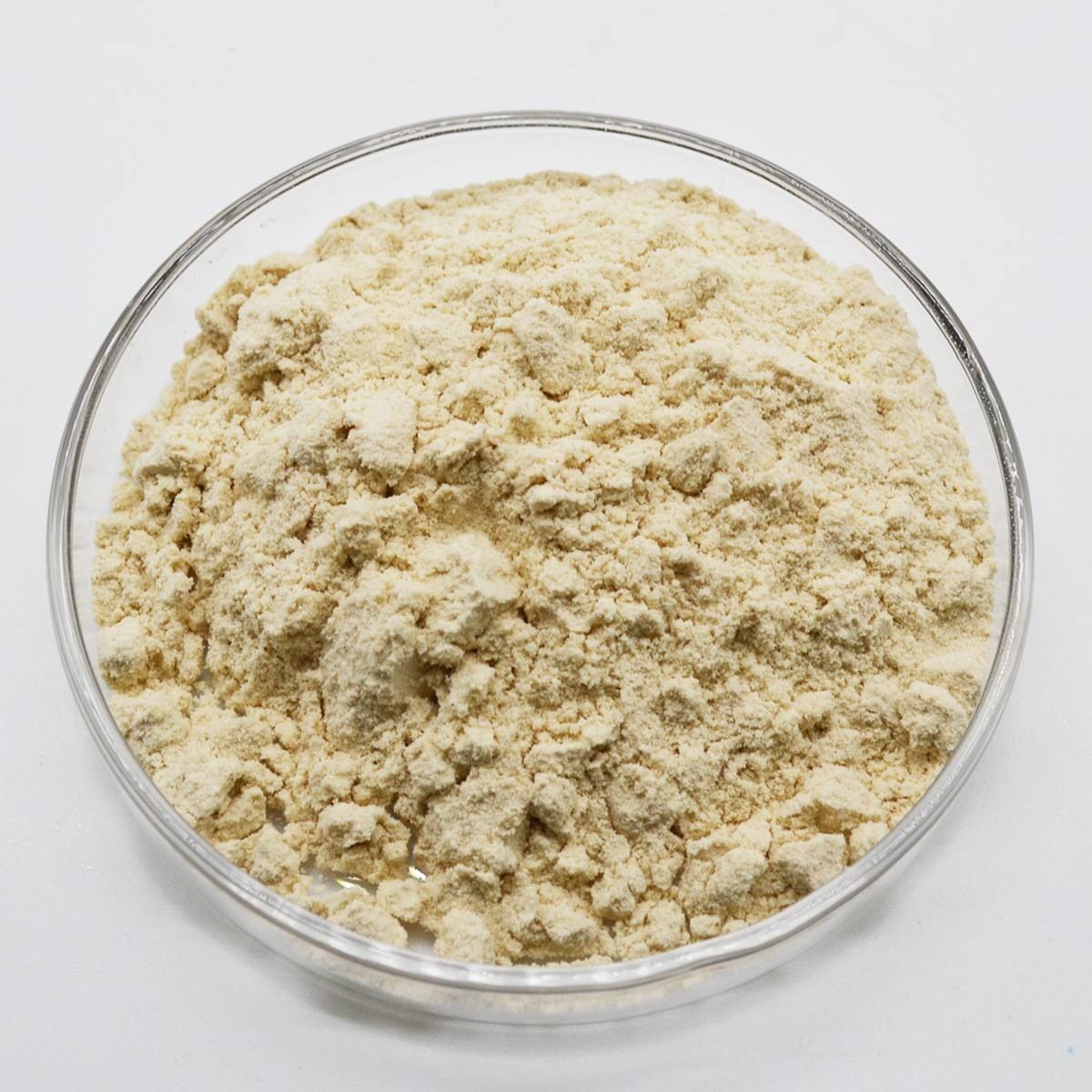
人参提取物粉末
人参根提取物,总皂苷10%-80%,可定制 Rg1/Re/Rb1
规格参数
- Product Name
- Pure Ginseng Extract Powder
- Botanical Name
- Panax ginseng C.A. Meyer (Araliaceae)
- Used Part
- Dried root
- Active Ingredients
- Total ginsenosides; markers Rg1, Re, Rb1
- Specification
- Total ginsenosides 10%~80% (HPLC); custom single markers available
- Test Method
- Total saponins by UV; ginsenoside markers by HPLC-UV (203 nm)
- Product Grade
- Food Grade; Pharmaceutical Grade
- Certificate
- ISO9001; GMP; Halal; Kosher; Organic; COA; MSDS
- Appearance
- Pale yellow to brown fine powder
- MOQ
- 1 kg (sample/trial); standard bulk 25 kg
- Shelf Life
- 24 months
1. What Is Pure Ginseng Extract Powder?
Pure Ginseng Extract Powder is a concentrated product made from the dried root of Panax ginseng, the Asian (or Korean) ginseng used for ages in East-Asian medicine as a tonic. The root is where the active compounds sit, so rather than dosing raw root powder, most brands buy an extract standardised to a set level of ginsenosides. Ginsenosides are the triterpene saponins the whole industry treats as the marker. Two groups matter: panaxadiol (Rb1, Rc, Rd) and panaxatriol (Rg1, Re).
Straight to the point on "pure". What that word means here is a single-species, root-based extract standardised to a named ginsenoside level and tested by HPLC, with no starch or maltodextrin bulking the number. It does not mean a perfect 100% figure, nothing in trade is measured that way. What you actually buy is the grade line and the COA that backs it. This page walks you through both.
Where Ginseng Extract Powder Is Used
Biggest volumes go into immune and anti-fatigue supplements and adaptogen / energy drinks. Then cognitive-mood formulas, cosmetics, and TCM / clinical work. Honestly, the use case decides the grade. A low-dose energy shot needs a high-assay extract so a teaspoon actually delivers. A standard capsule can get away with 10-20%. Sort your format first, then pick the number.
Why Source Through an Integrator
- One person handles the grade, the price and the paperwork end to end.
- Several mills in the loop, so a harvest or a maintenance hiccup somewhere does not stall your line.
- Batch COA with every lot, plus a third party can test before you pay.
- 1 kg trial lets you qualify the powder, then scale up.
2. Specifications & Common Grades
2.1 Standardized Total Ginsenoside Grades
These five cover nearly every enquiry. They are usually measured two ways, and the method matters more than people think (see below).
| Grade (total ginsenosides) | Typical use | Cost |
| 10% | Capsules, tablets, standard supplements | Lowest |
| 20% | Recovery / energy formulas, export brands | Low-mid |
| 30% | Premium supplements, higher-dosage formats | Mid |
| 50% | Concentrated shots, low-dose high-potency | High |
| 80% | High-assay powders, research, low-load drops | Highest |
2.2 UV vs HPLC — Know Which Number You Are Reading
There is a real trap here. A lot of extract is quoted on "total saponins" measured by UV spectrophotometry, which counts the saponin group as a lump. HPLC instead separates and quantifies the actual named ginsenosides, Rg1, Re, Rb1 and so on. UV is fine for a rough standard, but HPLC is the stricter one and what most premium buyers ask for. If a quote says 80% ginsenosides without saying which method, ask. The two can disagree by a lot on the same powder.
2.3 Typical Certificate of Analysis (Baseline)
Numbers below are representative across our mills. Your lot's own COA is what your QA signs off.
| Test Item | Specification |
| Identification | HPLC ginsenoside profile matches Panax ginseng reference |
| Total ginsenosides | 10 / 20 / 30 / 50 / 80% as quoted (HPLC) |
| Marker ginsenosides | Rg1, Re, Rb1 reported individually |
| Appearance | Pale yellow to brown fine powder |
| Loss on drying | ≤5.0% |
| Particle size | 95% pass 80 mesh (custom 100/200 available) |
| Heavy metals (Pb/As/Cd/Hg) | Pb ≤3, As ≤2, Cd ≤1, Hg ≤0.1 ppm |
| Residual solvents | Complies with USP |
| Total plate count | ≤1,000 CFU/g (or agreed limit) |
| Yeast & mold | ≤100 CFU/g |
| E. coli / Salmonella / S. aureus | Negative |
| Pesticide residues | Tested when required by market |
3. Species, Plant Part and the Authenticity Question
Ginseng is one of the most substituted botanicals on the market, and it is worth being blunt about why. A genuine Panax ginseng root takes years to grow, so it costs real money. Cheaper look-alikes exist. American ginseng (Panax quinquefolius), notoginseng (Panax notoginseng), or stem-leaf material are all cheaper to source, look similar as powder, and carry a different ginsenoside profile.
The split that bites most buyers is root versus stem-leaf. Root extract is the traditional, balanced profile and costs more. Stem-leaf extract can still show a high total ginsenoside number but with a different isomer mix, and it is cheaper. Neither is "bad", they are different products. What is bad is paying root price for stem-leaf, which is exactly what a vague COA lets someone do.
3.1 What a COA Should Actually Say
- The full Latin name and the plant part (root vs stem-leaf) stated, not implied.
- Pure Ginseng Extract Powder HPLC fingerprint matching a reference, plus a measured ginsenoside number, not just an "extract ratio".
- The analytical method (UV or HPLC) named on the document itself.
- Contaminant limits with per-element values, not just the word "complies".
If any of these lines are missing, treat it as a red flag rather than an oversight.
4. Quality, Certifications & Documentation
For an ingredient like this, the difference between a mill we trust and a repackager usually shows up in the file folder, not the sample jar. Here is the package we ship.
| Document | What it covers |
| Batch COA | Identity, ginsenoside assay + method, markers, contaminants, microbes |
| MSDS | Safe handling, storage, transport |
| Certificate of Origin | Growing region (e.g. Jilin) + processing site |
| Species / plant-part declaration | Root-only Panax ginseng vs other sources |
| Allergen & GMO statements | Clean-label support |
| Third-party report (optional) | Independent SGS / Eurofins verification |
| Stability summary | Shelf-life support |
Certifications behind a given lot usually include ISO 9001, ISO 22000 / HACCP, GMP, Halal and Kosher. Since we trade across several mills, the exact set is confirmed for each source and put in writing on your quote, not assumed.
Technically reviewed by
Dr. Claudia Bennett — botanical extracts and regulatory consultant, 20+ years on ginsenoside standardization, identity testing and US/EU supplement dossiers.
Last reviewed: September 2026.
5. Xi an Jianyuan Biotechnology — Your Integrated Supply-Chain Partner
We are not tied to one ginseng plant. We operate as a sourcing and trading outfit that keeps several qualified mills on the books, which matters for an ingredient like this one, because the raw root is seasonal, regional and increasingly expensive.
5.1 What Working With Us Looks Like
- We audit the mills on species authenticity, plant-part control, test lab and batch records before they go on our list.
- We match grade, root/stem-leaf and extraction type to your dosage form and your claim.
- Where it helps, we bring in a third-party lab so you are not betting on the mill's own numbers.
- Documentation travels with the order and is aligned to where you are shipping.
- For repeat volume we can lock an annual price so a bad harvest year does not reprice you overnight.
5.2 Processing Variants We Can Source
- White ginseng extract (dried root, not steamed) and red ginseng extract (steamed) have different profiles; we supply either to spec.
- Water-soluble grades for clear beverage use, and 80-mesh standard powder for capsules and tablets.
- Custom marker targets, e.g. a set Rg1+Re+Rb1 level, for brands standardising to a specific compound.
6. Sourcing & Market Notes
6.1 Where It Comes From
Jilin and Liaoning in northeast China are the main growing areas for Panax ginseng, with roots typically harvested after 4-6 years. Red ginseng means the root has been steamed, which shifts the profile. Beyond China there are growers in Korea and elsewhere. Most commercial extract is produced where the root grows or close to it, to keep the fresh material moving.
- Extraction is usually hot-water or hydroalcoholic, then filtered, concentrated and spray-dried.
- A root extract carries a premium over stem-leaf, so keep the plant part on the spec.
- The powder is hygroscopic, so moisture-barrier packing and cool dry storage matter.
6.2 Regulatory Quick Notes
- How ginseng is treated differs by market: food ingredient, dietary supplement, or traditional medicine.
- American ginseng can sit under CITES controls, another reason to nail the species on paper.
- Allowed claims vary; we flag the documents you will need when you order.
7. Buyer FAQ
- Q: What is the MOQ for pure ginseng extract powder?
A: 1 kg for samples and trials; standard bulk is 25 kg per drum. Larger volume gets tiered pricing.
- Q: What does "pure" mean here?
A: Single-species, root-based extract standardised to a named ginsenoside level by HPLC, with no bulking carrier inflating the number.
- Q: Which grade should I buy?
A: Depends on format. 10-20% for standard capsules; 30%+ for concentrated shots or low-dose high-potency lines.
- Q: Do you test by UV or HPLC?
A: We report the method on the COA. For most buyers, HPLC marker quantification (Rg1/Re/Rb1) is the safer spec.
- Q: Can you supply red ginseng extract?
A: Yes, steamed red ginseng extract is available to a separate specification.
- Q: Do you offer third-party testing?
A: Independent SGS / Eurofins analysis can be arranged and reported before shipment.
- Q: How is ginseng extract stored?
A: Cool, dry, sealed, away from light; shelf life is typically 24 months under these conditions.
- Q: What is the lead time?
A: In-stock grades usually ship within about a week; custom grades add time.
8. Request a Quote
Tell us the format you are making, the ginsenoside level you need, and the volume. We will point you to a grade and packing of Pure Ginseng Extract Powder that fits, and reply within one business day.
Email: [email protected]