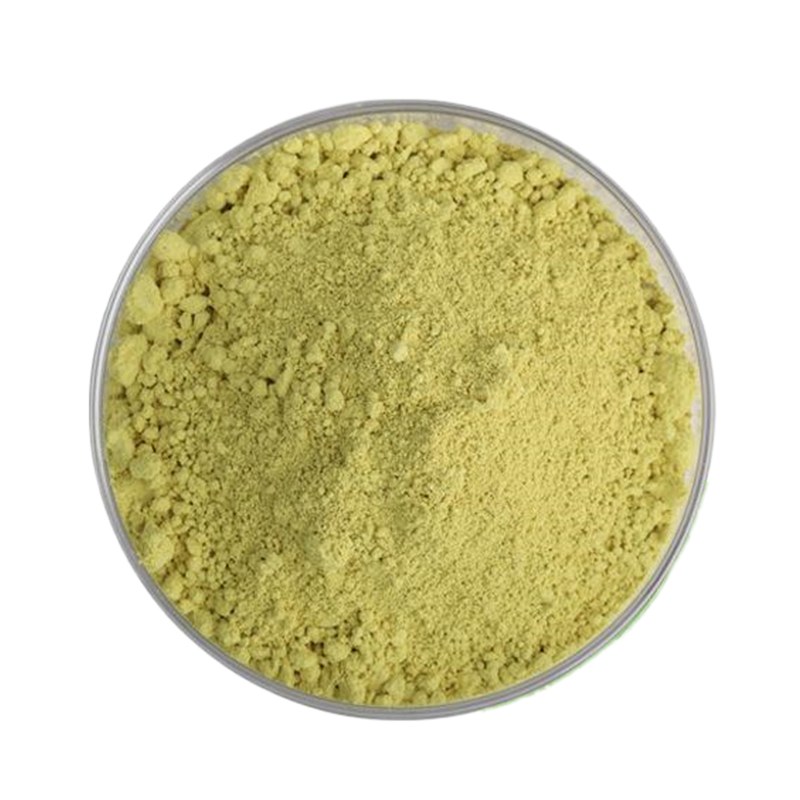
Pure Quercetin Powder 95% 98% Quercetin Dihydrate Sophora Japonica Extract HPLC Food Grade
Quercetin dihydrate / anhydrous 95%-98% (HPLC) from Sophora japonica
Specifications
- Product Name
- Pure Quercetin Powder / Quercetin
- Synonym
- Quercetin Dihydrate; Quercetin Anhydrous; 3,3',4',5,7-Pentahydroxyflavone; Meletin
- CAS Number
- 6151-25-3 (Dihydrate) / 117-39-5 (Anhydrous)
- Molecular Formula
- C15H10O7
- Molecular Weight
- 338.27 (Dihydrate) / 302.24 (Anhydrous)
- Plant Source
- Sophora japonica L. (Japanese pagoda tree flower bud)
- Used Part
- Flower bud (Huaimi)
- Specification
- Quercetin Dihydrate 95% & 98%; Quercetin Anhydrous 95% & 98%; Micronized Quercetin; Water-Soluble Quercetin
- Extraction Process
- Rutin extraction → hydrolysis → purification → crystallization
- Test Method
- HPLC (primary) / UV (on request) — HPLC data on every COA
- Product Grade
- Food Grade / Pharmaceutical Grade / Cosmetic Grade
- Certificate
- ISO 9001, HALAL, KOSHER, FDA-registered facility, REACH, COA, MSDS; Organic on request
- Classification
- Flavonoid / plant extract powder
- MOQ
- 1 kg sample / 25 kg standard order
- Shelf Life
- 36 months in sealed original packaging, cool and dry
- Appearance
- Yellow to greenish-yellow crystalline powder
- Odor & Taste
- Characteristic, slightly bitter
- Assay
- 95.0% – 98.0% (HPLC, on dried basis)
- Loss on Drying
- Dihydrate ≤ 12.0% / Anhydrous ≤ 5.0%
- Mesh Size
- 80 mesh standard; 100 mesh, 200 mesh or micronized (D90 < 10 µm) available
- Heavy Metals
- ≤ 10 ppm total (Pb ≤ 2 ppm, As ≤ 1 ppm, Cd ≤ 1 ppm, Hg ≤ 0.1 ppm)
- Residual Solvents
- Ethanol only, meeting ICH Q3C / USP <467> limits
- Solubility
- Practically insoluble in water; soluble in ethanol, DMSO and alkaline solutions
What Is Pure Quercetin Powder?
Pure Quercetin Powder is a flavonol that shows up in onions, apples, and tea, but nobody extracts it from those commercially — the yields are terrible. The industry makes it from Sophora japonica flower buds instead. Those buds are rich in rutin, you pull the rutin out with hot water or ethanol, hydrolyze off the sugar side chain, and what's left is quercetin. Same molecule, far cheaper.
The powder that comes out of that process is yellow, slightly bitter, and famously stubborn about dissolving in water. It's also one of the most widely used antioxidant actives in the supplement trade, which is why half the buying conversation ends up being about grade selection rather than price.
Grades and Specifications We Supply
Buyers usually come to us asking for "quercetin 95%", then discover there are a few decisions hiding inside that request. Here is the full range:
| Grade | CAS | Assay | Typical use |
| Quercetin Dihydrate | 6151-25-3 | 95% HPLC | Capsules, tablets, powders. The volume workhorse. |
| Quercetin Dihydrate | 6151-25-3 | 98% HPLC | Premium supplement lines, tighter label claims. |
| Quercetin Anhydrous | 117-39-5 | 95% HPLC | Where potency per gram matters or formulas are water-sensitive. |
| Quercetin Anhydrous | 117-39-5 | 98% HPLC | Pharmaceutical and high-end nutraceutical work. |
| Micronized Quercetin | 6151-25-3 | 95% HPLC | D90 < 10 µm. Better flow, faster dispersion in dry blends. |
| Water-Soluble Quercetin | 6151-25-3 | ~80% HPLC | Beverages, shots, ready-to-mix powders. |
| Sophora Japonica Extract | — | 95% Quercetin | When your label needs the botanical name rather than the isolated compound. |
Not all of these sit in stock year-round. The dihydrate 95% and 98% grades usually do; anhydrous and water-soluble runs we schedule, so give us two to three weeks on those.
Dihydrate vs Anhydrous: Which One Should You Buy?
This question comes up on almost every first enquiry, and the answer is usually less exciting than people expect.
Dihydrate carries two water molecules in its crystal structure, anhydrous does not. That makes the molecular weights 338.27 and 302.24 respectively, so on a straight weight-for-weight basis anhydrous delivers roughly 12% more actual quercetin per gram. If your formula is dosed by weight, that matters. If you are filling 500 mg capsules and the label claim is what drives the purchase, dihydrate 95% is nearly always the better value, and it is by far the most traded grade in the market.
Anhydrous earns its price in two situations: when water content in the blend is a problem (some effervescent and dry-powder systems), or when a customer is standardizing to a pharmacopoeial monograph that specifies it. Otherwise you are paying more per gram of active for no functional gain.
A Note on HPLC vs UV Assay
Worth being blunt about this one, because it causes more disputes than any other spec on a quercetin COA.
UV spectrophotometry measures total flavonoids at a given wavelength. It is fast and cheap, and it reads high — sometimes by 8 to 15 percentage points — because related flavonoids absorb in the same region. A lot that shows 95% by UV can come back at 82% by HPLC. We have had buyers bring us a competitor quote at "quercetin 95% UV" that was, on our HPLC, an 84%. That is not fraud necessarily; it is a looser method. But it is not the same product.
We run HPLC as the release method and print it on every COA. If your existing supplier quotes UV and the price looks unusually good, ask them for the HPLC number before you compare. If you specifically need UV testing to match an internal SOP, we can run both and report them side by side.
The Solubility Problem (and What We Do About It)
Standard quercetin is close to insoluble in water. Around 0.01 g/L at room temperature, which in practice means it will not stay in a clear beverage and the body absorbs only a small fraction of what is swallowed. Every buyer who has tried to put plain quercetin into a drink mix has run into this.
Three ways around it, all of which we supply:
Micronized grade: same chemistry, particles milled to D90 under 10 µm. Larger surface area, better dispersion, moderate gain in uptake. Cheapest option and it works fine in capsules and dry blends.
Water-soluble grade: spray-dried with a carrier so it disperses in cold water. Suited to beverages, shots, and stick packs. Assay lands around 80% quercetin by HPLC because of the carrier load — factor that into your dosage math.
Phytosome / liposomal systems: complexed with lecithin for a large jump in bioavailability. The most expensive route, and the one to use when the product is sold on absorption claims.
Which one you need depends entirely on the dosage form and what the label is allowed to say. Tell us the finished product and we will narrow it down quickly.
Where Bulk Quercetin Powder Goes
Dietary supplements
The biggest slice of our volume. Capsules and tablets, usually 250–500 mg per serving, often stacked with bromelain, vitamin C, zinc, or rutin. Quercetin also shows up in immune, cardiovascular, and sports recovery formulas. Dihydrate 95% is what most of these customers run.
Functional food and beverage
Fortified powders, wellness shots, and sports nutrition. This is where the solubility conversation becomes unavoidable — standard grade will settle out of a clear drink, so these customers almost always take micronized or water-soluble.
Cosmetics and personal care
Anti-aging serums, after-sun and soothing products, occasionally oral beauty supplements. Used as an antioxidant and for its calming effect on skin. Volumes are smaller than supplement work but margins are better.
Animal nutrition
Poultry, aquaculture, and pet supplements. Quercetin is used here for antioxidant support and gut health. Price sensitivity is higher in this segment, and buyers usually want the 95% dihydrate in 25 kg drums.
How We Make It
Sophora bud sourcing, rutin extraction, hydrolysis, purification, drying and milling, release testing, then get the pure quercetin powder. Where this tends to go wrong:
Bud quality varies by harvest and region. We buy from the same growing areas each season and assay rutin content on intake, because a weak starting material pushes up cost and pulls down yield.
Hydrolysis has to run to completion. Partial hydrolysis leaves rutin in the powder, which inflates a UV reading and fails an HPLC check. We test for residual rutin specifically for this reason.
Heavy metals and pesticide residues are the two things that most often fail a customer's intake testing. Both are tested per lot, and we will share the raw chromatogram if your QA wants to see it.
Milling and packing happen under controlled humidity. Quercetin picks up moisture readily and clumps, which then causes flow problems on a capsule machine.
Packaging, MOQ and Lead Time
Samples: 100 g or 1 kg foil bag. Billed at cost and normally credited against your first order.
Standard: 25 kg fiber drum with double PE liner. Around 300 kg per pallet.
Smaller packs: 5 kg foil bags when customers want to avoid opening a full drum.
Custom: private label pouches, bottles, or bulk bins for contract manufacturers.
Lead time: stock grades ship in 5–10 days. Anhydrous, micronized, and water-soluble runs take about 2–3 weeks.
Certificates and Documents
Every shipment leaves with a COA showing HPLC assay, loss on drying, heavy metals, and microbiologicals. MSDS, allergen statement, non-GMO statement, and residual solvent data come standard. HALAL, KOSHER, and REACH documentation on request; organic certified material is available but it is a separate sourcing chain, so ask early if you need it.
One practical note: if you are importing into the EU or the US, tell us the destination at quote stage. Quercetin is handled as a novel food ingredient in parts of Europe, and the paperwork your customs broker needs depends on how it is declared. We have shipped into both markets for years and can flag the likely sticking points before you place the order.
What We Actually Solve for Buyers
Plenty of suppliers can ship a drum of yellow powder. The parts that usually cause trouble are these:
Grade selection. Send us your dosage form and label claim and we will tell you which grade genuinely fits. We have talked customers out of anhydrous more than once, because dihydrate did the same job for less.
Assay method alignment. If your QC runs a different HPLC method than ours, send the SOP. We will run it and report against your conditions so your intake test and our COA agree.
Spec matching. Tight window on heavy metals, particle size, or residual solvent? We will adjust the purification or milling to hit it rather than ship something marginal and argue about it later.
Documentation. Standard folder with every order, plus whatever else your regulatory team or import broker asks for.
Supply continuity. Annual contracts with reserved stock if you are running steady volume. Spot shipments if you are not.
OEM and private label. Blends with bromelain, rutin, vitamin C, or zinc, packed to your retail spec.
Why Work With Us
Experience
Over a decade in botanical extracts, with quercetin shipped to supplement brands, contract manufacturers, and distributors across North America, Europe, Southeast Asia, and Australia. We have seen the ways this ingredient causes problems — moisture pickup, assay disputes, failed heavy metal screens — and we plan around them instead of discovering them mid-order.
Expertise
In-house HPLC and UV capability, plus routine heavy metal, pesticide, and microbiological testing through accredited partner labs. Our QC team will match your method if you have one, and we keep retained samples from every lot.
Authority
ISO 9001 certified, HALAL and KOSHER certified, FDA-registered facility. We supply contract manufacturers who audit us, and we are happy to put you in touch with existing customers if you want references before committing.
Trust
Batch records traceable to the bud lot, retained samples on every batch, third-party testing whenever you want it, and payment terms that do not put the entire risk on your side. One account manager who answers email.
Frequently Asked Questions
What is the difference between quercetin dihydrate and anhydrous?
Dihydrate contains two water molecules in its crystal structure, anhydrous does not. Anhydrous delivers about 12% more quercetin per gram by weight. For most capsule and tablet work, dihydrate 95% is the better value and it is the most widely traded grade. Anhydrous makes sense when water content in the formula is a problem or when a monograph specifies it.
Are your assays tested by HPLC or UV?
HPLC is our release method and it appears on every COA. UV reads higher because related flavonoids absorb at the same wavelength, so a "95% UV" product can test in the low 80s by HPLC. If a competitor quote looks unusually cheap, ask for the HPLC number before comparing. We can run UV as well if your internal SOP requires it.
What grades do you keep in stock?
Quercetin dihydrate 95% and 98% are normally on the shelf and ship in 5–10 days. Anhydrous, micronized, and water-soluble grades are made to schedule, so allow 2–3 weeks.
Can quercetin be used in beverages?
Not in its standard form — it is practically insoluble in water and will settle out. For drinks, shots, or ready-to-mix powders, take the water-soluble grade (around 80% assay due to the carrier) or a micronized grade. We will help you pick based on the finished product.
What is the MOQ, and can I get a sample?
Sample quantities start at 100 g, with 1 kg foil bags being the usual trial size. Standard orders are 25 kg drums. Samples are billed at cost and typically credited against your first order.
Which documents ship with the order?
COA with HPLC assay, loss on drying, heavy metals and microbiologicals, plus MSDS, allergen statement, non-GMO statement, and residual solvent data. HALAL, KOSHER, and REACH on request. Ask at order stage so everything goes in the same shipment.
What is the shelf life and how should it be stored?
36 months in the original sealed packaging, stored cool and dry. Once opened, reseal the liner tightly — quercetin picks up moisture and will clump, which then causes flow problems on filling equipment.
Do you offer organic quercetin?
Yes, but it depends on organic Sophora bud availability for the season, and it is a separate sourcing chain with a higher MOQ. Ask early if organic is a requirement.
Get a Quote or a Sample
Tell us the grade, the assay you need, your volume, and where it is going. We will come back with pricing, a COA of pure quercetin powder, and a straight answer on whether we are the right supplier for you. If we are not, we will say so.
Email: [email protected]